

 English
 中文简体

ANGSHEN
ANGSHEN
ANGSHEN
ANGSHEN
ANGSHEN
ANGSHEN
ANGSHEN
ANGSHEN
ANGSHEN
ANGSHEN
ANGSHEN
ANGSHEN
ANGSHEN
ANGSHEN
ANGSHEN
ANGSHEN

China Flux for Aluminum: A Buyer's Guide to Grades, Specs and Supply Chains
Content
- 1 What the Chinese Flux Supply Base Actually Offers
- 2 Flux Families and the Specification That Separates Them
- 3 What to Put in the RFQ: Six Points That Prevent Rework
- 4 Calcium, Magnesium and Sodium: Managing the Contaminants
- 5 Quality Signals Worth Checking Before You Order
- 6 Where Chinese Flux Procurement Goes Wrong
- 7 FAQ
- 8 Next Step: Buy the Specification, Not the Name
A purchasing engineer at a secondary aluminum plant sends out an RFQ for "refining flux, 25 kg bags, five tonnes." Four quotes come back from China within the week, all within 8% of each other, and all four products behave differently in the furnace: one releases gas too fast for the rotary degasser, one leaves a wet slag on the surface, and one has caked solid in the bag before it ever reaches the ladle.
The conclusion first: China is a workable and usually cost-effective source for aluminum flux, but only when you buy a written chemistry and a documented melt behaviour instead of a product name. "Refining flux," "drossing flux" and "degassing tablet" describe a function. Behind each label sits a salt blend whose melting range, granule size, moisture and sodium content decide whether the material helps your melt or quietly adds cost.
What the Chinese Flux Supply Base Actually Offers
Producers there tend to organise their catalogues around three functional groups, and almost every quotation you receive will belong to one of them.
- Refining and degassing fluxes: granular blends or pressed tablets that strip hydrogen and non-metallic inclusions in the holding furnace or in-line degasser.
- Drossing and dross-separation fluxes: salts that raise the metal yield recovered from skimmed dross and keep the dross friable instead of pasty.
- Function-specific fluxes: calcium removal, magnesium depletion control, sodium-free refining for alloys where sodium is restricted, and multi-effect cleaning grades for high-scrap charges.
Packaging is fairly standard industry-wide: 25 kg moisture-barrier bags, 1 t big bags, and tablets in sealed drums or cartons. Much of the production sits in the same industrial belt as secondary aluminum and master alloy plants, which matters less for unit price than for logistics — a plant a few hours from Shanghai or Ningbo shortens the inland leg and cuts the time a container spends waiting in humid air.
One caution before you compare quotes: identical names do not mean identical products. A "high-efficiency refining flux" from one plant may be a near-eutectic NaCl-KCl blend with fluoride additions and a fast gas release; another plant ships a higher-melting mix that behaves completely differently in the same degasser. Compare chemistry and behaviour, not labels.
Flux Families and the Specification That Separates Them
Five families cover most purchasing inquiries. The right-hand column is where quotations usually diverge — and it is the column buyers most often leave blank.
| Flux family | Primary function | Application point | Decisive specification |
|---|---|---|---|
| Refining / degassing flux | Remove hydrogen and inclusions | Holding furnace, rotary degasser, transfer ladle | Gas-release rate, granule size, moisture |
| Drossing / dross-separating flux | Recover trapped metal from dross | Skimming ladle, dross pan | Melting range, exothermic behaviour, yield per tonne of dross |
| Calcium-removal flux | Reduce calcium in contaminated melts | Transfer ladle, melting furnace | Dose rate and achievable calcium reduction |
| Sodium-free refining flux | Refine without introducing sodium | Foil, aerospace and selected 5xxx/7xxx alloys | Verified total sodium, chloride balance |
| Magnesium depletion flux | Control magnesium loss in scrap-heavy charges | Melting furnace | Depletion rate, fume level, slag condition |
If the furnace runs several alloy families in the same week, a single grade is always a compromise. It is worth reviewing how flux chemistry maps to specific aluminum, copper and zinc melts before one product is written into a long-term contract.
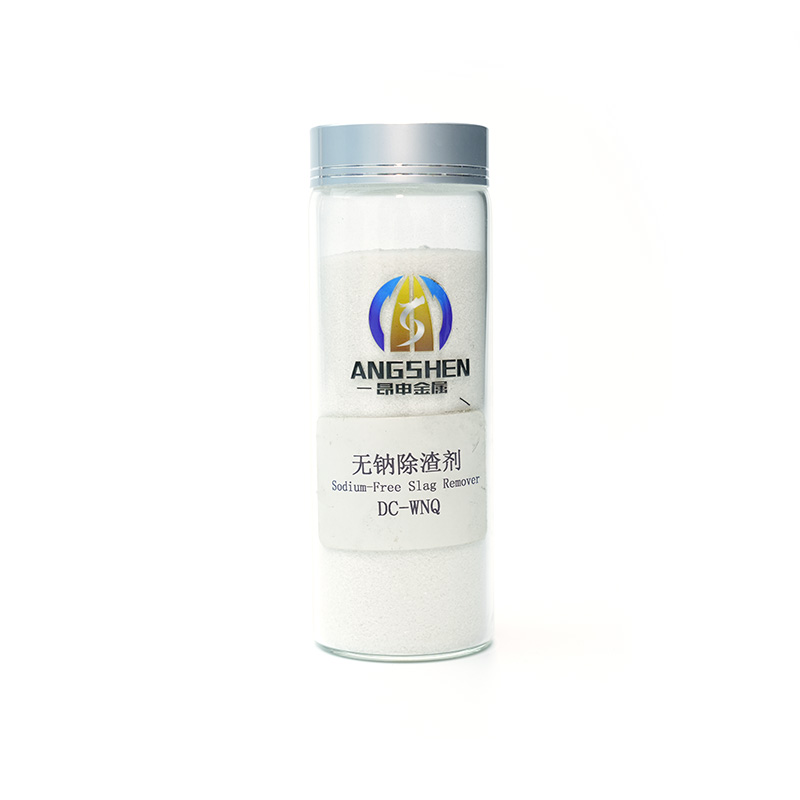 Sodium-Free Refining Flux for Aluminum MeltsSodium-free refining flux for aluminum melts, with 0.1–0.4% dosing and 1–5 kg packs, gives purchasing teams a concrete specification to compare.View Product →
What to Put in the RFQ: Six Points That Prevent Rework
A flux quotation without a specification is simply a price for an unknown. These six items turn a product name into something a purchasing team can actually compare and receive.
- Salt chemistry with tolerances. Ask for the weight percentage of every component and the permitted deviation; roughly ±1.5% absolute on major salts is a realistic band for a controlled blend.
- Melting range against your process temperature. A flux that melts above your transfer-ladle temperature floats and does nothing. State your operating window and ask the supplier to confirm overlap in writing.
- Granule size distribution. Roughly 0.2–1 mm for injection and rotary degassing, 1–3 mm for surface application on dross. Oversize granules dissolve too slowly; fines blow straight out of the lance.
- Moisture as shipped. Specify ≤0.5% with a moisture-barrier inner liner. Chloride blends pick up water in a humid container, and wet flux means hydrogen — the exact contaminant you were removing.
- Dose rate and expected result. Kilograms per tonne of melt for refining; kilograms per tonne of dross plus an expected metal recovery for drossing. A cheap drossing flux that leaves metal in the dross is the expensive option.
- Batch documentation. Certificate of analysis per batch, batch number printed on every bag, retained sample. This is where a manufacturer separates from a trader buying on the spot market.
Dross handling is the easiest place to prove a number. Run a paid trial on your own dross before scaling, and ask for the recovery figure in writing rather than in a brochure.
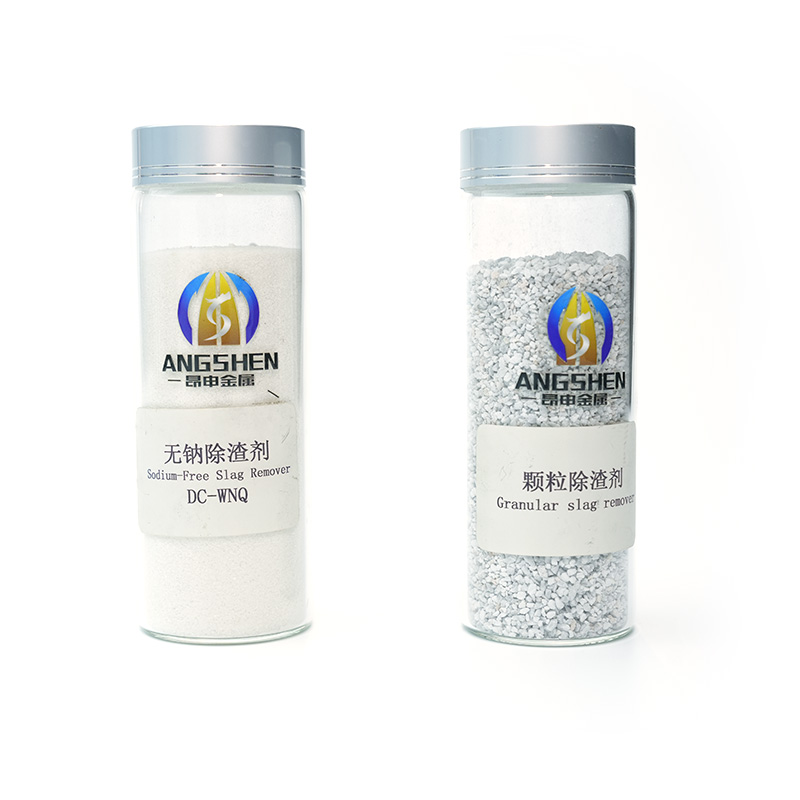 Aluminum Dross Separating Flux for Die-Casting and RecyclingDrossing flux for aluminum melting above 700°C, dosed at 0.2–0.4%, separates oxide dross and supports recovery checks in die-casting or recycled-metal operations.View Product →
Calcium, Magnesium and Sodium: Managing the Contaminants
Recycled scrap brings calcium, magnesium and sodium into the melt, and each behaves differently. Calcium raises hot-cracking sensitivity in several alloys and is stubbornly hard to remove once in solution; magnesium is often deliberately alloyed and then has to be held inside a narrow band rather than removed; sodium at trace levels is harmless in many castings but unacceptable in foil and certain aerospace specifications.
That is why function-specific fluxes exist. A calcium-removal flux shifts the melt chemistry so calcium leaves the metal and reports to the slag, and its real value depends on the reduction achieved per kilogram added — a figure the supplier should quote and the buyer should verify from ladle samples taken before and after treatment.
Magnesium depletion flux is the mirror case: the goal is controlled loss, not maximum removal. Overdosing produces a burnt, dusty dross that costs more metal than it saves.
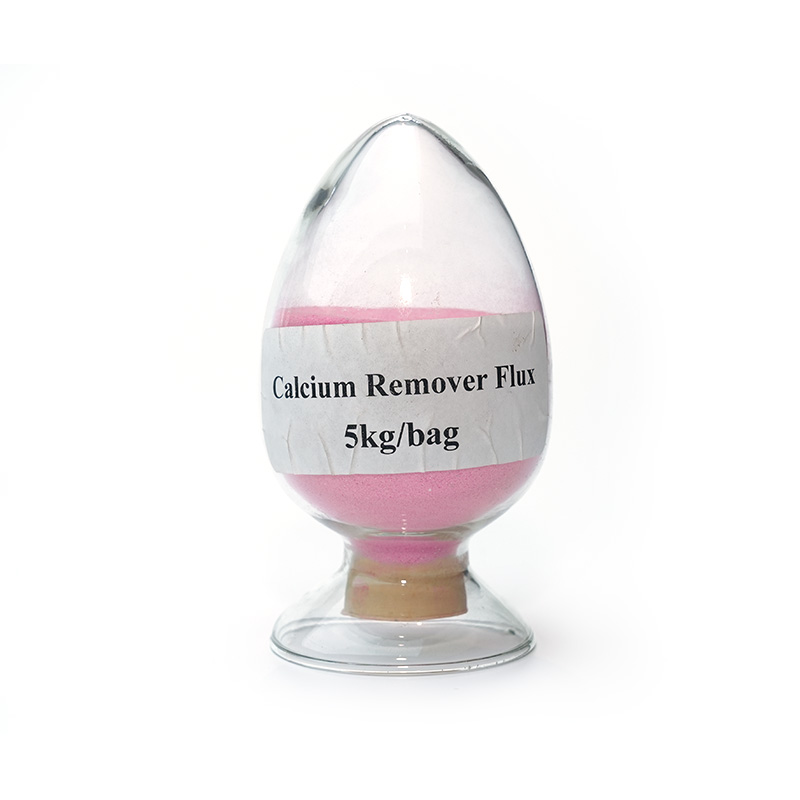 Calcium Remover Flux 1# for Aluminum Alloy MeltsCalcium-removal flux for aluminum alloys, dosed from measured calcium at roughly 7–8 kg per kilogram removed, offers a specification-led option for high-calcium recycled melts.View Product →
Quality Signals Worth Checking Before You Order
Certificates are easy to display and harder to verify, so focus on the auditable ones. A GJB9001C quality management certification points to a system built for military-standard traceability, which matters for a flux plant because it forces batch-level records instead of campaign averages.
Physical scale matters in a different way. A supplier running a 48,000 m² plant with dedicated flux, tablet and master alloy lines, its own compaction equipment and humidity-controlled storage can hold a formulation stable across repeat orders. A trader sourcing from several small workshops cannot, and the drift shows up as a change in granule colour, flow behaviour or slag texture. Walking or auditing the manufacturing base — production lines, storage conditions and how batches are segregated — answers more questions than any catalogue page.
Where Chinese Flux Procurement Goes Wrong
- Moisture picked up in transit. A container crossing the Indian Ocean in high humidity will attack a paper-only bag. Specify a foil or PE liner plus a desiccant policy.
- Batch-to-batch drift. Without a retained sample and a certificate per batch, a second shipment can differ in granule size and still carry the same product name.
- Classification confusion. Metallurgical flux does not sit in one tidy HS heading, so confirm the code the supplier will declare and check that the duty rate stays stable between shipments.
- Under-specified trials. Testing 25 kg by hand in a ladle tells you very little about behaviour in a five-tonne rotary degasser.
- Price-led substitution. When a cheaper carbonate filler replaces part of a chloride blend, performance drops long before anyone notices the invoice changed.
FAQ
Is Chinese aluminum flux actually cheaper than domestic supply?
Usually on unit price, not always on cost per tonne of treated metal. Once moisture losses, dose rate and metal recovery are counted, a mid-priced product with a stated dose rate often beats the lowest quote.
What is the difference between refining flux and drossing flux?
Refining flux treats the metal — it removes hydrogen and inclusions inside the melt. Drossing flux treats the by-product — it makes skimmed dross release trapped aluminum. The two are not interchangeable.
Can I get a genuinely sodium-free refining grade?
Yes, but ask for the total sodium figure rather than the phrase. Sodium-free blends substitute other salts for sodium chloride and usually cost more; a supplier who cannot quote a number has not tested it.
What order size makes sense for a first trial?
Enough to run a full production campaign, typically 500 kg to 2 t, so the trial reflects real dosing equipment rather than hand application in a ladle.
How long does delivery take?
Production lead time and ocean transit are two separate numbers. Ask for both in writing, plus the port of loading, before comparing landed cost between suppliers.
Next Step: Buy the Specification, Not the Name
Flux is one of the smallest line items in an aluminum melt shop and one of the fastest ways to lose money quietly. The workable approach with Chinese suppliers is straightforward: define chemistry, granule size and moisture limits; require batch documentation; trial at production scale; then hold the same specification across repeat orders.
Do that, and the quote comparison turns into a technical comparison — the only one that predicts what happens in the furnace.
PREV:China Flux for Aluminum Factory: Applications, Selection Criteria, and Practical GuidanceNEXT:China Aluminum Strontium Master Alloy Supplier: AlSr5, AlSr10, AlSr15, AlSr20 Grades
Interested in cooperation or have questions?

- Quick Link
- HOME
- PRODUCTS
- NEWS
- SOLUTION
- CONTACT US
- Contact information
-
-
wmfan0222@163.com

-
+86-13167461999

+86-18252891222(WhatsApp) -
+86-0513-88275999

-
No.19 HeshunHaian Economic Development Zone, Nantong, Jiangsu, China

-

