

 English
 中文简体

ANGSHEN
ANGSHEN
ANGSHEN
ANGSHEN
ANGSHEN
ANGSHEN
ANGSHEN
ANGSHEN
ANGSHEN
ANGSHEN
ANGSHEN
ANGSHEN
ANGSHEN
ANGSHEN
ANGSHEN
ANGSHEN

China Flux for Aluminum Factory: Applications, Selection Criteria, and Practical Guidance
Content
- 1 What "Flux for Aluminum" Covers in a Chinese Catalogue
- 2 Match the Flux to the Failure Before You Compare Prices
- 3 The Datasheet Items That Decide Whether the Flux Works
- 4 Vetting a China Flux Factory Before the First Container
- 5 A Trial Plan That Produces a Number, Not an Opinion
- 6 Why the Cheapest Bag Rarely Wins on Cost per Tonne
- 7 Practical Questions Buyers Ask
Two quotes for the same line item land on the same purchasing desk: 25 kg bags of aluminum refining flux, both produced in China, both quoting the same base chemistry. One is 38% cheaper per tonne. Three months later, the cheaper bag is the expensive one — the melt is dosing 1.4 kg per tonne instead of 0.9 kg, the dross comes out heavier, and two heats a week fail the porosity check on the same castings.
The bag price is only the entry ticket. What an aluminum plant actually buys is a treatment cost per tonne of acceptable casting, and that number is set by chemistry, granule size, moisture control, dosage and the supplier's batch-to-batch consistency — not by the number on the quotation.
This guide is written for foundry, melt-shop and purchasing teams evaluating China flux for aluminum factory operations. It covers the product families you will be quoted, how to work backwards from the defect you are trying to remove, what to insist on in a datasheet, what to verify in the plant, and how to structure a trial that ends with a comparison figure rather than an impression.
What "Flux for Aluminum" Covers in a Chinese Catalogue
In Chinese supplier literature, "flux" is an umbrella term for salt mixtures that do three different jobs: protecting the melt surface, cleaning the melt, and separating metal from dross. Mixing up those three is the single most common sourcing error, because a drossing flux used as a refining flux will not degas anything, and a refining flux used to loosen dross will simply burn off.
| Family | Primary job | Symptom that triggers the order |
|---|---|---|
| Cover / protective flux | Builds a liquid barrier over the melt, limiting oxidation and hydrogen pickup | Long holding times, transfer ladles, rising gas content before casting |
| Refining flux (granule or tablet) | Breaks down oxide films, helps hydrogen escape, cleans the melt | X-ray porosity, inclusion spec failures, clogged ceramic filters |
| Drossing / dross-separating flux | Raises dross temperature and releases entrapped metal | Dross that still looks metallic, high metal loss per heat |
| Calcium remover | Binds and removes calcium picked up from scrap | Calcium drifting above spec as scrap ratio increases |
| Magnesium depletion flux | Deliberately lowers magnesium in the melt | Secondary 6xxx-type scrap pushing Mg above the casting range |
| Sodium-free refining flux | Refines without adding sodium | Strict sodium limits on high-magnesium or aerospace-type alloys |
A supplier with a genuine production line will separate these into distinct product codes with distinct chemistry. If the same bag is offered for every job, the chemistry is almost certainly a compromise blend.
Match the Flux to the Failure Before You Compare Prices
Work backwards from the defect or the cost line you want to remove, then buy the flux that addresses it. Four situations cover most purchases.
Porosity, oxide inclusions and filter blockage
This is a refining problem. Granule refining flux is dosed into the furnace or ladle, usually in the 0.1–0.3% of charge weight range, and works best alongside a rotary degasser with argon or nitrogen — the flux helps release and float out oxides, but the inert gas still does most of the hydrogen removal. Granule size matters here: fines below roughly 0.2 mm tend to burn off above the bath before they ever reach the melt, so a sieve analysis is more informative than the bag price.
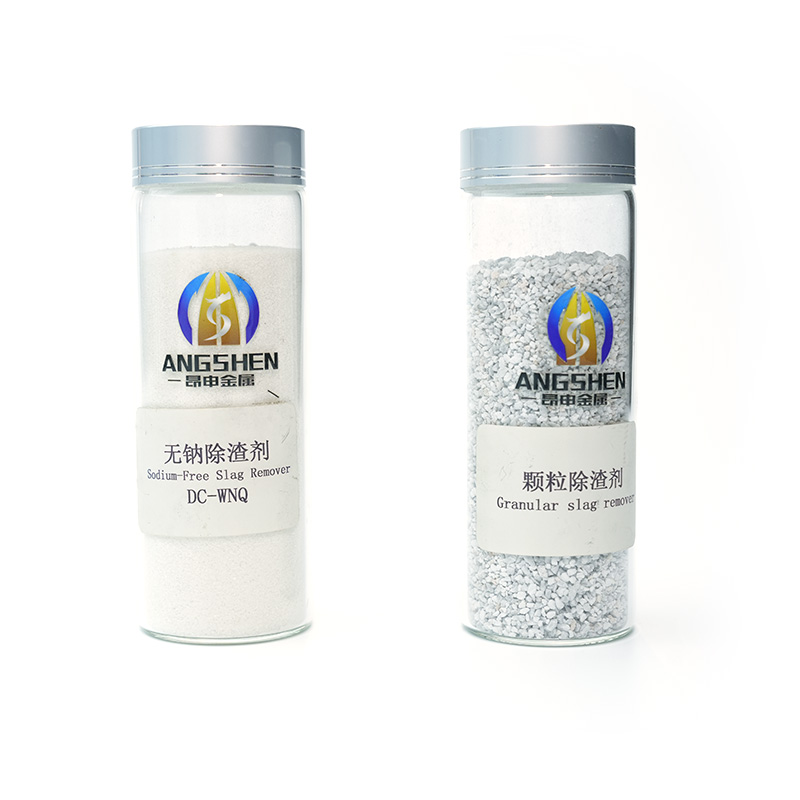
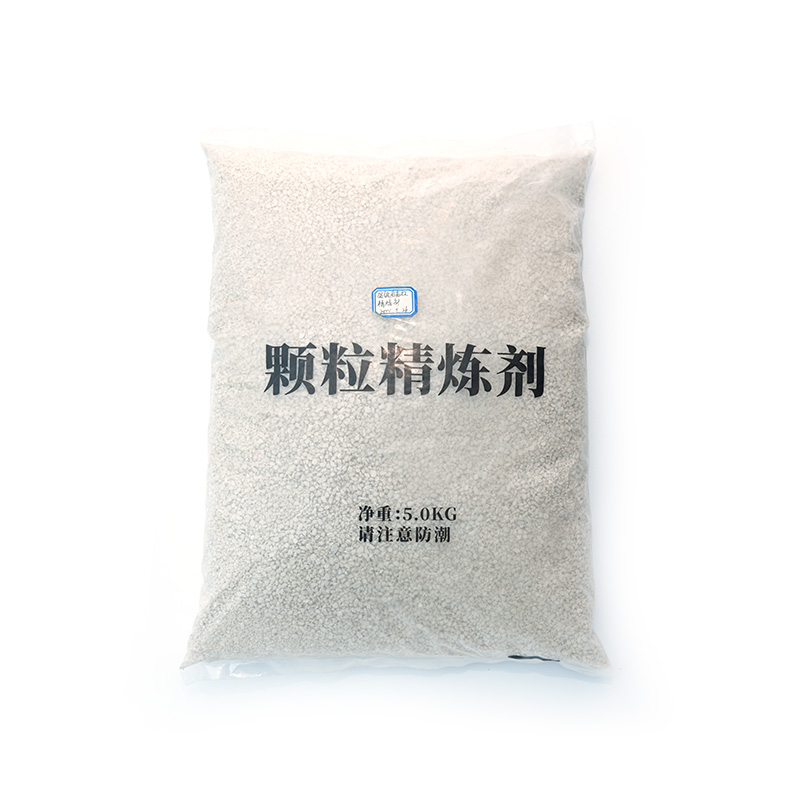 Granule Refining Flux for Aluminum Melt PurificationGranular flux adsorbs oxide inclusions and forms dry slag, supporting cleaner aluminum melts at 700–720°C with low smoke.View Product →
Dross that still carries recoverable metal
If a poke test on cooled dross shows a high metallic content, you are losing metal every heat. A dross-separating flux raises the temperature in the dross layer so entrapped aluminum coalesces and returns to the bath. The commercial proof is simple: weigh dross per heat before and after, and compare the metallic yield at the dross processor.
 Dross Separating Flux for Die-Cast and Recycled AluminumHigh-efficiency drossing flux helps separate oxide slag above 700°C, making skimmings dry and loose to reduce aluminum loss.View Product →
Calcium climbing as scrap ratio rises
Calcium accumulates quietly when secondary scrap enters the charge, and it degrades fluidity and mechanical properties long before anyone notices a defect pattern. A calcium-remover flux is a corrective measure, not a substitute for charge control — if you are dosing it on every heat, the problem is in the scrap mix, not the flux.
Sodium and magnesium limits
Some alloys cannot tolerate sodium, and the sodium-free route exists precisely for those grades. Magnesium is the opposite case: when recycled scrap pushes Mg above the specification window, a magnesium depletion flux is used deliberately to bring the melt back into range, with sampling before and after as the only reliable control.
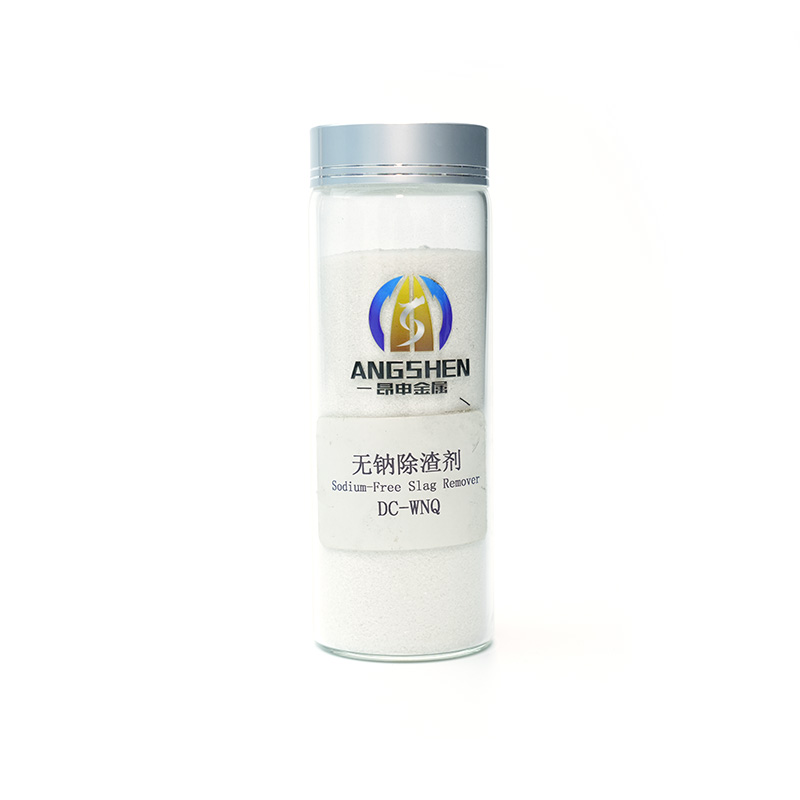 Sodium-Free Refining Flux for Aluminum Alloy MeltsSodium-free flux purifies aluminum melts at 700–740°C, helping avoid sodium embrittlement in alloys needing high plasticity or anodizing.View Product →
The Datasheet Items That Decide Whether the Flux Works
Chinese flux suppliers often share a short brochure rather than a specification. Ask for the following items in writing, and treat missing data as a risk factor rather than a formatting quirk.
| Item | What good looks like | Risk it controls |
|---|---|---|
| Base chemistry | Declared chloride/fluoride content with a tolerance band, not a single figure | Fluoride level drives oxide-film breaking; excess attacks crucible lining and increases fume |
| Moisture | A stated figure, typically well under 0.5%, plus an inner moisture-barrier bag | Damp flux introduces hydrogen and shows up directly as porosity |
| Granule size | Sieve analysis curve, for example 0.2–2 mm with fines capped | Dust burns off before reaching the bath; oversize granules dissolve too slowly |
| Flowability | Free-flowing after sea freight, no caking in the bag | Caked flux makes screw or auger dosing unreliable and skews consumption figures |
| Working temperature | Melting range below your normal bath temperature | Undissolved flux residues end up counted as inclusions |
| Batch traceability | Batch number printed on the bag, COA available per batch | Lets you isolate a suspect delivery to specific heats instead of the whole container |
| Packaging | 25 kg inner-lined bags or 1 t big bags, palletized, desiccant in the container | Container humidity during sea freight is a real, recurring cause of rejects |
A supplier who cannot produce a sieve analysis and a batch COA on request has answered the question for you, however competitive the quotation looks.
Vetting a China Flux Factory Before the First Container
The audit question is not "can this plant make flux" — plenty can. It is "can this plant make the same flux in month nine, batch after batch, and prove it on paper". Five checks separate the two groups.
- Process ownership. Does the plant melt and cast its own master alloys and press its own tablets, or does it buy in and blend? A single site running automated master alloy lines, a metal tablet line and a dedicated flux line controls the chemistry it feeds into every downstream product — the production base described on the factory page is a useful reference for what that footprint looks like.
- Quality certification with a scope. Ask for the certificate number and the scope line, not just a logo. GJB9001C or ISO 9001 certification tells you a system exists; the scope tells you whether flux production is actually covered.
- Batch discipline. Request consecutive COAs for the same product across several months and compare the spread. Consistent chemistry with narrow variation is worth more than an impressive single analysis.
- Technical reply quality. Send a real problem — alloy grade, furnace type, current dosage, defect pattern — and see whether the answer contains numbers, dosages and a proposed trial design, or only reassurance.
- Export paperwork. Confirm SDS availability, a non-hazardous declaration where applicable, consistent HS classification through your own broker, and palletized loading. Fluoride-bearing blends may carry labelling obligations in your market, so have the SDS reviewed rather than assumed.
A Trial Plan That Produces a Number, Not an Opinion
Most flux disputes come from trials without a baseline. Run the sequence below and the decision becomes arithmetic.
- Define the KPI first. Hydrogen content in cc/100 g of aluminum, porosity level on a standard casting, dross weight per heat, or calcium level after treatment. One KPI per trial, agreed before samples ship.
- Establish a baseline. Three to five heats on the current flux, same furnace, same degassing time, same measurement method.
- Test a sample. 25–50 kg is enough for a first comparison. Keep dosage, melt temperature and holding time identical to the baseline; change one variable only.
- Scale to a working quantity. 500 kg to 1 t reveals bag-to-bag consistency — granule size variation, caking, colour differences — which a sample never shows.
- Fix commercial terms around the result. Once consumption per tonne is known, negotiate price basis, MOQ, lead time, chemistry tolerance and packaging on that basis rather than on a headline rate.
Why the Cheapest Bag Rarely Wins on Cost per Tonne
Treatment cost per tonne of melt equals bag price multiplied by consumption, plus the value of metal lost in dross, plus rework and energy. A supplier quoting a lower bag price with a higher consumption rate loses on the first multiplication alone.
An illustrative comparison: at 0.9 kg per tonne, a higher-priced flux at 900 per tonne costs about 810 per 1,000 tonnes of melt. At 1.4 kg per tonne, a 700-per-tonne flux costs about 980 for the same output — before counting the extra dross, the additional degassing time and the occasional rejected heat. Add a 1% swing in metal yield on a 1,000-tonne annual melt and the gap widens by an order of magnitude.
This is why serious buyers request a dosage figure in writing, tied to a specific alloy and furnace type, and then verify it during the trial. A dosage claim that cannot be reproduced on your line is a sales number, not a specification.
Practical Questions Buyers Ask
Is a Chinese flux order subject to import restrictions?
Most aluminum fluxes are non-hazardous chloride and fluoride salt blends, but fluoride content can trigger labelling and transport documentation requirements in some markets. Have the SDS reviewed locally and confirm HS classification with your broker before the first shipment.
What is a sensible minimum order for a first trial?
25–50 kg for a bench or single-furnace comparison, 500 kg to 1 t for a production trial, then standard 20–25 t container loads. A supplier unwilling to support the first two steps is usually a trader, not a producer.
Does refining flux replace rotary degassing?
No. Flux assists oxide removal and helps hydrogen release, but inert-gas degassing is still the main mechanism for hydrogen removal. Buying more flux to compensate for insufficient degassing is an expensive way to stay out of specification.
How do I verify granule size consistency across a container?
Ask for the sieve analysis with the COA, then take three bags from different pallet positions and screen them yourself. Fines content is the figure that matters most for refining grades.
How long should the whole evaluation take?
Six to ten weeks is realistic: two weeks for documentation and samples, three to four weeks for the production trial, and the remainder for commercial terms and a follow-up order.
Buying flux from China is not difficult; buying a reproducible treatment cost is. Confirm the product family against the defect you are removing, demand chemistry, moisture and sieve data per batch, check that the plant owns its production process, and let a controlled trial — baseline, sample, working quantity — produce the number that decides the contract.
If you are sourcing for a specific alloy and furnace setup, send the details through the contact page and ask for a dosage recommendation with a matching sample, so the comparison starts from your melt rather than from a catalogue.
PREV:China Manganese Tablets for Aluminum Alloying: A Supplier Selection GuideNEXT:China Flux for Aluminum: A Buyer's Guide to Grades, Specs and Supply Chains
Interested in cooperation or have questions?

- Quick Link
- HOME
- PRODUCTS
- NEWS
- SOLUTION
- CONTACT US
- Contact information
-
-
wmfan0222@163.com

-
+86-13167461999

+86-18252891222(WhatsApp) -
+86-0513-88275999

-
No.19 HeshunHaian Economic Development Zone, Nantong, Jiangsu, China

-

